A Sarajevo guesthouse can look wonderfully convenient on a map and still leave you facing a steep final climb. When stairs are a concern, the useful question is not simply how close a property is to the old town. It is how you will get from your arrival vehicle to your room, and from that room to the places you want to enjoy each day.
You do not need to rule out a small guesthouse, or give a host your medical history, to make a sensible choice. You do need specific answers. I would build the booking around three things: the approach from the street, the complete route to the bedroom, and a comfortable walking radius that includes somewhere to eat and rest.
Start with the ground, not the map pin
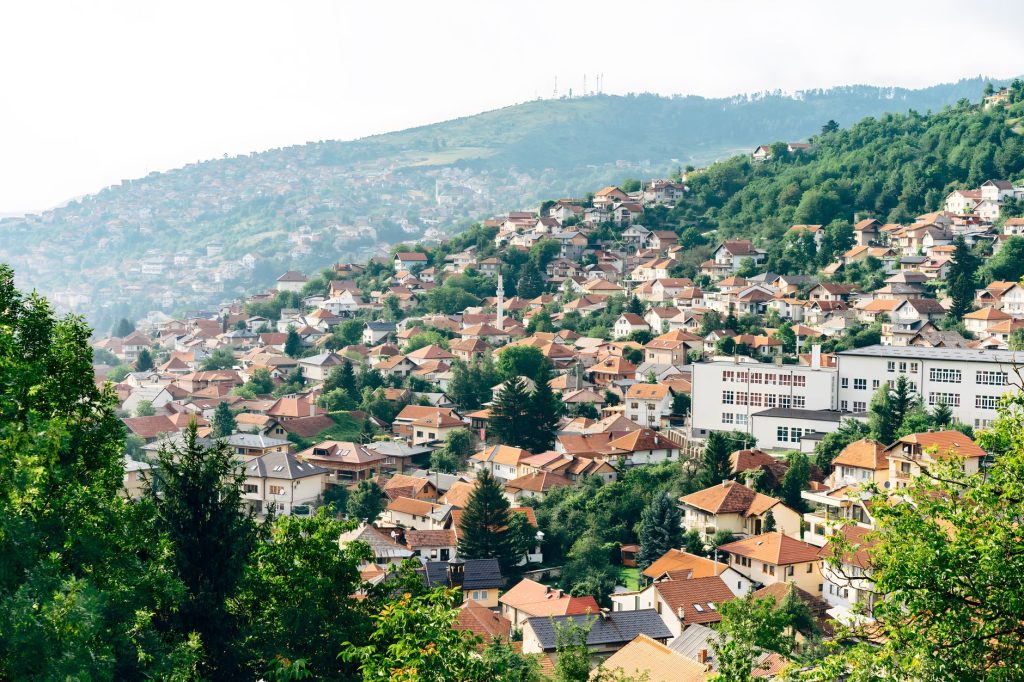
Sarajevo occupies a valley with neighbourhoods rising onto the surrounding slopes. Around the historic centre, a short distance on a booking map can conceal an uphill lane. Two guesthouses that appear equally close to Baščaršija may offer very different walks home.
Use the map to identify possible locations, then treat the approach as a separate part of your research. Look for descriptions of hills, steps, narrow lanes and uphill walks in guest comments. Words such as “views” or “above the centre” are reasons to ask more questions, rather than reasons to reject a place automatically.
Be precise about what makes a route difficult for you. A steady incline, a short steep slope, uneven paving and steps without a handrail are different obstacles. “Is it easy to walk there?” invites a subjective answer. “Does the route from the nearest vehicle stopping point include steps or a steep uphill section?” is more useful.
Ask about the entire route to your room
A ground-floor room does not necessarily mean access without stairs. There could be steps at the gate, a raised entrance, or a staircase between reception and a separate accommodation building. Equally, a room described as being on the first floor may be interpreted differently by guests and hosts.
Ask for a description that starts where you would leave a taxi and ends at the bedroom door. If a host has several rooms, make sure the answer concerns the room you can actually reserve. A general description of the property is not enough when one room is accessible by a different entrance.
- How many steps are there from the street to the entrance?
- How many further steps lead to this particular room?
- Are the stairs indoors or outdoors, and is there a continuous handrail?
- Is there a lift, and does it serve both the entrance level and the room floor?
- Are the bathroom and any included breakfast area on the same level?
- Can the confirmed room and floor be recorded in the booking?
If step dimensions, doorway width or space for a mobility aid matter, request measurements. A photograph of the entrance and staircase can help clarify an answer, but it cannot establish every detail. If you require an entirely step-free route, say so explicitly and confirm thresholds as well as staircases.
Check where a vehicle can actually stop
“Taxi access” can mean several things: a car can reach the front door, a driver can stop at the end of the lane, or the host can meet you nearby. These arrangements have very different consequences when you have luggage and limited energy.
Ask for the exact drop-off location and the remaining distance to the entrance. Find out whether that final section slopes, has steps, or involves uneven ground. A pedestrian area or narrow approach may affect access, so ask whether the suggested stopping point works at your expected arrival time.
A useful follow-up is: “Could I be dropped off there with my luggage, even if the car cannot remain parked?” Parking availability and passenger drop-off are separate questions. If you are arriving in your own car, also check the walk from the actual parking space rather than assuming it is beside the building.
Send one clear message before booking
You can keep the enquiry friendly and brief while making your needs unambiguous. State what you can comfortably manage, then ask the host to describe the route. For example:
“I am interested in booking your guesthouse, but stairs and steep slopes are difficult for me. Could you confirm the number of steps from the closest taxi drop-off point to the available room, including any entrance steps? Please also describe any uphill walking, whether there are handrails, and whether the bathroom is on the same level. I would need the room and floor confirmed with the reservation.”
Adapt that wording to your own limits. If you can manage a few steps but not a full flight, explain that distinction. If the answer is only “no problem”, follow up for the missing details. A reassuring tone is welcome; concrete information is what lets you decide.
Keep the reply with your booking information. Before committing to a restrictive cancellation policy, resolve any uncertainty that would determine whether you could use the room comfortably.
Plan arrival as part of the stay
An otherwise manageable approach can feel much harder after a journey. Aim to arrive with enough time to find the entrance without rushing. Daylight can make unfamiliar paving and changes in level easier to judge, although your transport schedule may not allow it.
Send the host your approximate arrival time and confirm how you will get inside. Ask whether someone will be there, whether luggage assistance is available, and whether that assistance needs arranging in advance. Do not assume that a small guesthouse has staff present throughout the day or night.
Save the address, entrance instructions and host’s telephone number somewhere you can access without a connection. If the entrance is on a different street from the map pin, ask for that distinction in writing. Share the agreed drop-off point with your driver rather than relying solely on the property’s name.
Pack so you can manage the final approach safely. A smaller bag may be easier on steps, while a wheeled case may suit smoother ground. Choose around your own balance and strength, and arrange help when carrying luggage would make an otherwise acceptable route difficult.
Build a comfortable walking radius
Choose your base around an ordinary day, not just a list of sights. You will want breakfast, an evening meal and somewhere to sit without turning every outing into a demanding walk. Check the route to these essentials as carefully as the route to the guesthouse.
Baščaršija and the central streets around Ferhadija can serve as familiar reference points when discussing location with a host. Being near them does not guarantee a level approach, an easy doorway or suitable paving. Ask which route offers the gentlest gradient, even if it is longer than the shortest route shown on a map.
For the first outing, keep the plan modest: a meal, a short look around and a return while you still have energy. Notice where you can pause and how the return journey feels. A downhill departure can disguise an uphill walk home, so judge the route in both directions.
Compare the total effort and cost
A lower room rate may be less useful if the location leads to repeated vehicle journeys or makes you reluctant to go out again after resting. Compare the accommodation cost with the transport you expect to need, without assuming that a central address will solve every access issue.
I would favour the guesthouse whose host can explain the entrance, guarantee a suitable room and give clear arrival instructions. A modest view and a manageable route can make a better base than a dramatic outlook reached by a climb. The right choice leaves you enough energy to enjoy Sarajevo once you have put your bag down.